Keep connected
Our investment management team is made up of engaged thought leaders. Get their latest commentary and stay informed of their frequent media interviews, all delivered to your inbox.
John Zechner
October 1, 2026
Interest rates from two years to thirty have surged throughout 2026 to levels not seen since the bubbly economic days just prior to the housing bubble in 2008. We though, continue to expect these rates to reverse direction, contrary to the consensus view. One of the bigger triggers for a decline could come from the oil market. For bonds, the enemy has been oil and the Fed’s reaction function to oil. What had been a long-standing +30% direct correlation between WTI oil and the 10-year T-note yield has surged these past three months to an incredible 90% statistical relationship. So, the question is what happens to crude? The one thing we do know is that the last time hopes sprung eternal for a U.S.-Iran deal last June, WTI did, for a short while, dip below $70 per barrel and during that time, the 10-year yield was cut back to 4.4%. While negotiations between the U.S. and Iran look to be going nowhere, both sides want to see an end to this conflict. For the U.S. they want to see oil prices come down to relieve the pressure on headline inflation as well as longer term interest rates. For Iran, they have been unable to sell any oil since July due to the U.S. naval blockade and have therefore run down their currency reserves and support for their domestic economy. The good news is that the tankers in the Red Sea have begun loading oil in a major way from the Saudi Arabian East-West pipeline that was shut down this month after it was damaged in an attack. A total of nine tankers on the Red Sea coast have loaded about 12.5 million barrels of crude since Sunday. The workaround aside, Saudi Arabia and the United Arab Emirates in recent weeks have been steering vessels through the Strait of Hormuz with the help of the U.S. Navy. So, what we see is that crude shipments from Saudi Arabia, the U.A.E., Qatar, Bahrain, Kuwait, and Iraq improved in September and reached the highest levels since the war began and are now just around -20% below the monthly average prior to the conflict.
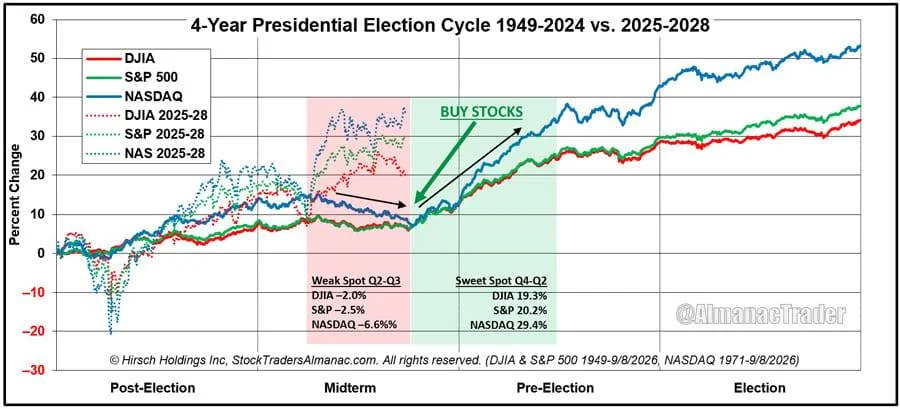
While almost all of our commentary on the market has been a mix of negativity and caution, here’s one for the bulls. Market weakness has been modest and seasonally normal, and stocks are now entering the historically favourable sweet spot of the Four-Year Presidential Cycle, extending from the 4th quarter of the midterm year through the second quarter of the pre-election year. This is reflected in the chart below, which covers election cycles over the past 75 years. What is clearly notable this year versus the prior cycles average is that we didn’t see stock market weakness in the second and third quarters of prior midterm election years. That means that stocks are starting from a relatively high point and therefore may have less total upside if prior trends do indeed persist.
Spinning all the commentary above into an investment strategy in the current environment argues for a continued defensive stance! We remain slightly underweight stocks but have used some of our cash reserve to add to positions in the bond market, particularly the long-term (30 year) U.S. Treasury bond, which is now trading with a yield of almost 5.6%. In the stock market, we had lightened up our position in gold stocks following the somewhat ‘hawkish’ views from the Federal Reserve following their last meeting. Higher U.S. rates would support some further strength in the U.S. dollar, which is a clear headwind for the gold sector. However, we continue to be bullish on gold longer-term due to continued aggressive buying from central banks (China, Poland, India and Turkey were all buyers over the last three months). The ‘debasement trade’ is another long-term support for gold as we see the massive debt expansion globally (lead by the U.S. with debt now over $40 trillion) leading to more diversification by major investment funds away from fiat currencies, with some of that selling ending up in gold. On top of all that, gold stock valuations remain near multi-decade lows. Our focus is on domestic producers with little or no exposure to geo-politically sensitive areas such as West Africa, parts of South America, the Middle East and southeast Asia. Our top holdings included Agnico Eagle Mines, Torex Gold and Equinox Gold.
Due to our view that there might be some breakthrough in the U.S.-Iran conflict that would lead to a drop in oil prices, we did lighten up on some of our exposure to the producers (i.e. Cenovus, Whitecap Energy and Canadian Natural Resources) and moved those funds into the pipeline stocks (TC Energy, Enbridge and Pembina Pipeline) which have been under pressure the past few months since they are more ‘interest sensitive’ and therefore hurt by the recent rise in interest rates. However, we maintain a smaller position in the oil producers and would look to add on any significant weakness since we believe that there is a strong case to be made for a structural bull market in Energy stocks in Canada. In fact, the Canadian energy is in better shape today than in any cycle in the past few decades. While the near term is less clear (possibility at any time for a surprise Hormuz deal; oil at war-premium levels; heightened trade tensions with the U.S.), the long-term case is strong due to the geo-political stability in Canada, the lon-lived nature of the oil sands reserves and the new commitment by the federal government to support energy infrastructure investments in Canada and increasing the openness of the investment opportunities for foreign investors. We also see better market access as the Trans Mountain Expansion has substantially improved access to Pacific markets, reduced dependence on U.S. refineries, and narrowed the historical Canadian WCS (Western Canadian Select) discount. That was the main structural weakness in earlier cycles.
Other sectors we added to included telecoms in Canada, which have been hurt recently by the increase in interest rates and over the last few years due to increased competition in wireless and slower population growth due to reduced immigration. However, the four major wireless players seem to have settled into a competitive market without aggressive price cuts. Valuations are exceptionally low, dividends are now at sustainable levels and the yields are attractive. We added to existing positions in BCE Inc. and Rogers Communications as well as putting Telus back into the portfolio as it traded below $12. Power utilities and renewable energy also look attractive in this environment where we are looking for less economic sensitivity, high dividend yields and positive growth opportunities. A final sector that we find attractive in Canada is the Industrial Products group, particularly those companies which will benefit from the expected surge in capital spending and infrastructure as part of the governments new global diversification efforts. Attractive names we added to recently include CAE Inc. and WSP Global while continuing to hold positions in AtkinsRealis and MDA Space.
Within technology we have taken our positions down slightly on recent stock strength and some concerns about growth expectations, financing requirements and the sustainability of the massive AI spending that has fuelled industry growth over the past three years. In Canada we sold Celestica and reduced positions in Shopify while continuing to hold Constellation Software. In the U.S. we sold Salesforce on the strength post earnings and reduced holdings in Meta on the September surge as well as Oracle due to some worries over their rising ‘off balance sheet’ debt obligations. We maintain positions in the major hyperscalers, Alphabet, Amazon and Microsoft. We continue to hold no bank stocks in Canada (for now) due to what we view as overly optimistic earnings expectations, excessive valuations and reduced dividend yield support.
1 2
Our investment management team is made up of engaged thought leaders. Get their latest commentary and stay informed of their frequent media interviews, all delivered to your inbox.