Keep connected
Our investment management team is made up of engaged thought leaders. Get their latest commentary and stay informed of their frequent media interviews, all delivered to your inbox.
John Zechner
August 4, 2026
Looking ahead for stock markets, we are heading into what are the seasonally weakest three month of the year. As an aside, a few of my clients and readers of this letter have commented to me on the seemingly negative tone of most of my comments about the stock market recently. While I would never argue the fact that stocks have the best long-term returns of any asset class and it is always best to remain invested, I have also seen enough down cycles to know that it is very important to point out the risks faced by investors at any point in time and whether those risks are more prominent than they have typically been. If so, it always makes sense to be more prudent in both your allocation to stocks in general as well as the selection of sectors to focus on. With those risks currently as elevated as we have seen them in a few years, our sector and stock focus is on low valuations, less economic sensitivity and higher dividend yields.
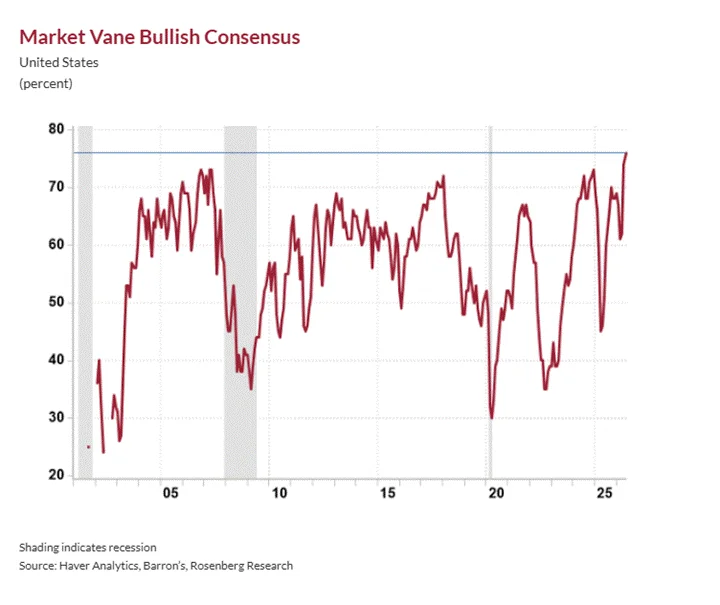
One ongoing worry is how bullish most investors are and how aggressively their portfolios are positioned. Market Vane bullish sentiment hit the highest level in its history in June at 76%. It was sitting at 68% at the end of 2025 and 51% exactly a year ago. Only two other times was the index close to where it is now — April 2007 and January 2018. In the year after the former, the S&P 500 was unexpectedly down -6.4%, and a year after the latter, down -6.5%. In both cases, few believed the stock market could ever go down again. In 2007, we had the housing mania, which was a version of today’s AI mania, and in 2018, we were coming off the epic Trump tax cuts fuelling euphoria at the time. Manias and euphoric behaviour have this nasty historical tendency of mean-reverting.
If investors are inclined to take the ‘contrarian view’ then the bond market is the most obvious candidate. Everyone is very concerned that interest rates are heading higher and inflation is no longer under control. Meanwhile, the newly ‘capital starved’ technology sector has turned into a major player in corporate bonds, putting upward pressure on yields to attract additional buying interest. But, while stock market optimism is at record levels, similar measures for the bond market are at record lows of under 30% bullish. U.S. long term bonds at yields of over 5.25% are looking to us like a great hedge against both potential stock market weakness as well as economic risks to the downside if the ‘one-legged stool’ of U.S. growth hits any speed bumps.
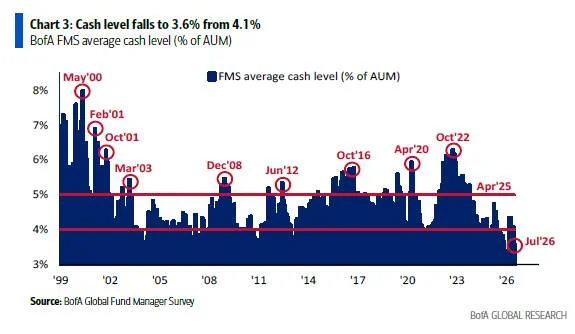
Also, investors aren’t just ‘talking the talk.’ They are also ‘walking the walk’ as shown in the chart below of average cash levels in Bank of America client accounts. Low cash levels line up better with market tops rather than bottoms. We can argue that investor sentiment is not necessarily a good stock market indicator since it is so highly volatile, but investor cash levels do tell a better story as to ‘what investors are doing rather than what they are saying.’ On that count, cash levels have fallen to the lowest level in over 25 years.
Another concerning fact for us is that U.S. executives are selling shares at the second-fastest pace in more than 20 years, a classic red flag to some investors because it suggests people with the most corporate knowledge are wary about markets. Corporate insiders sold $77.6 billion of stock during the first half of 2026, a 20% increase from a year ago, according to EPFR Global Market Intelligence. The only time the selling spree was more intense was back in 2021, when markets were flush with pandemic-driven stimulus cash. In contrast, stock buying by corporate insiders has been subdued. They purchased just $6.9 billion worth of shares in the first half. That’s only modestly above the seven-year low of $6.7 billion recorded a year earlier. Insiders remain reluctant to increase personal equity exposure, even as equity markets have continued to advance. To us this is a better indicator of the outlook than corporate stock buybacks. It is one thing for a board of directors to authorize using corporate cash to support stocks and improve earnings per share, but it is a totally different story for those same executives to put their own hard-earned wealth behind the same theory. While corporate buybacks are reaching record highs, insiders seem to be running in the other direction!
Central banks back in buying mode in the gold market. Based on the latest reported data, official gold reserves increased by a net 41 tonnes during the month, with purchases once again concentrated among a familiar cast of buyers. Much of the activity was driven by Poland (18t) and China (10t), with Uzbekistan and Kazakhstan also continuing their monthly net gold buying activity. Singapore also rejoined the list of buyers, reporting a net purchase of 4t, its first monthly net purchase since September 2025. Meanwhile, net sellers for the month were Turkey (3t) and Russia (6t) with year-to-date sales of 81t and 34t respectively. Central bank selling experienced a sharp increase in March, right after the bombing in Iran began. Russia and Turkey have been the largest sellers as they needed to shore up their currency reserves due to risks from the war. But central bankers remained positive on the role of gold in their reserves, with 89% of central bankers expecting global gold reserves to increase in the next 12 months. Meanwhile, a record high 45% of central bankers expect their own institution’s gold reserves to increase over the next 12 months
Most market watchers have been surprised that oil markets have not been stronger given the almost complete shutdown of gulf region exports due to the blockage in the Straits of Hormuz. While the release of strategic reserves early in the conflict helped moderate the rise in prices, the fact that this has gone on so much longer than everyone expected has not lead to higher oil prices. In fact, prices actually dropped to below US$70 per barrel during the brief period following the short-lived MOU between the U.S. and Iran. The mitigating factor appears to have been the sharp drop in oil imports by the largest player in the market. China is more in control of its oil consumption than anyone realized. During one of the worst energy crises in history, brought on by the Iran war, the crude market’s top customer cut imports by 40%. China’s need for oil has turned out to be very discretionary, which gives Beijing sway over where oil prices head next. China went on a crash diet with oil soon after the Strait of Hormuz closed. The country imported 11.6 million barrels of crude a day on average in 2025, data from the American Petroleum Institute shows. By June this year, imports had collapsed to around seven million barrels a day. A single-country drop of that size hasn’t happened before, even during a major recession. China’s economy grew 4.3% in the second quarter. This was a slowdown from the first three months of the year, but hardly something that would be associated with a collapse in energy consumption. The pullback in oil purchasing has acted as a shock absorber for the global economy, keeping a lid on prices, and was a big surprise to commodities traders. They are now trying to figure out how much longer China can stay quiet in the market. Changes in consumer behaviour also reduced demand for oil-based fuels. More people drove electric vehicles instead of gasoline cars or took high-speed electric trains instead of domestic flights. China has also been the world’s largest investor in renewable energy. Bottom line is that China has always been an astute player in commodity markets. Over the past year they had been adding aggressively to oil inventories, which allowed them this ability to sharply cut back imports during the conflict. If investors want to follow their playbook, China has also been one of the largest buyers of gold over the past two years and they have also been active buyers of uranium and copper.
Much of what was discussed in this letter I also talked about on an interview early in July on the TD Active Trader Live Show
1 2
Our investment management team is made up of engaged thought leaders. Get their latest commentary and stay informed of their frequent media interviews, all delivered to your inbox.