Keep connected
Our investment management team is made up of engaged thought leaders. Get their latest commentary and stay informed of their frequent media interviews, all delivered to your inbox.
John Zechner
August 4, 2026
Looking at the returns for major stock averages in July one might conclude that it was a somewhat uneventful month. That couldn’t be further from the truth as July was almost the total reverse of June in terms of sector moves with massively increased volatility. The S&P500 dropped about 2% on the month and the TSX gained around 2% on a sharp recovery in the energy sector but the real action was in the reversal of the ‘AI picks and shovels trade’ which saw the semiconductor index fall almost 20% while the laggard hyperscaler and software stocks rallied. No where was the volatility more apparent than in South Korea’s Kospi Index, which has a massive weight of over 50% in two memory chip (HBM) makers. Despite rallying 17% on the final day of July, the index was down 22% on the month but is still up more than 53% so far this year. This caused South Korea’s financial regulators to intervene to restrict access to single-stock leveraged ETFs, directly pointing to them as a key driver of extreme market volatility in giant semiconductor stocks like Samsung Electronics and SK Hynix.
We also saw some aggressive dominos fall in the U.S. market as one of Wall Street’s fastest-growing funds devoted to artificial intelligence investments was unravelling. In a matter of weeks, hedge fund Situational Awareness went from managing roughly $45 billion to being forced into a sweeping reduction of its listed-stock positions as a historic momentum reversal triggered losses on both sides of its portfolio and set off margin calls and compulsory sales. Situational Awareness had built concentrated and financially levered positions in one of Wall Street’s most popular trades: owning companies expected to supply the chips, data centres, power and other infrastructure behind the AI boom while betting against software firms viewed as vulnerable to the technology’s disruption. As the value of the portfolio fell, the fund’s equity cushion shrank and its prime brokers demanded additional collateral. Raising cash required selling more holdings, adding further pressure to sliding stocks and generating additional losses. What might otherwise have been a painful drawdown became a deleveraging spiral. Estimates now have the value of the fund being around $10 billion. This story reminded me a bit of the collapse of LTCM (Long Term Capital Management) in 1998, one of the most famous cautionary tales in financial history. Founded in 1994 by legendary Salomon Brothers bond trader John Meriwether, LTCM seemed unbeatable—its team included Nobel Prize-winning economists Myron Scholes and Robert C. Merton. For its first few years, the fund generated massive profits. However, an over-reliance on mathematical models, extreme leverage, and an unexpected global crisis brought it to the brink of total failure in just a few weeks. The lesson here for all investors remains the same. Investing in high momentum sectors of the market create inherent risks, but those risks are elevated when financial leverage is added to the equation. With margin lending in the U.S. at record levels, investors should probably expected similar levels of volatility in the months ahead.
The recent heightened volatility in the semi-conductor stocks and the whole technology sector was driven by the very important information gleaned from the earnings releases of the major U.S. cloud tech names; Amazon, Microsoft, Alphabet and Meta. The market reaction highlights a shift in investor sentiment after more than three years of enthusiasm surrounding AI, ever since ChatGPT debuted in late 2022. While demand for AI services continues to grow, investors are increasingly questioning whether hyperscale tech companies can earn attractive returns on the hundreds of billions of dollars they’re committing to data centres, AI chips and networking infrastructure. There were two key pieces of information coming from those four reports that would drive the investment outlooks; what would be the ongoing commitment to higher levels of capital spending and how well are these companies monetizing this spending through growth in their public clouds? We have written over the last few months as to the risks we see with the ‘one-legged stool’ of U.S. growth. The combined capital spending of over US$800 billion this year on capex related to AI and data centres has been a massive tailwind for not only the tech sector, but also electric utilities, construction companies, the banks and investment dealers that finance this spending and the stock market’s wealth effect that has empowered high net worth consumers to spend beyond their means. Any deceleration or reversal of this spending would remove the largest tailwinds for growth in the U.S and the rest of the industrial world.
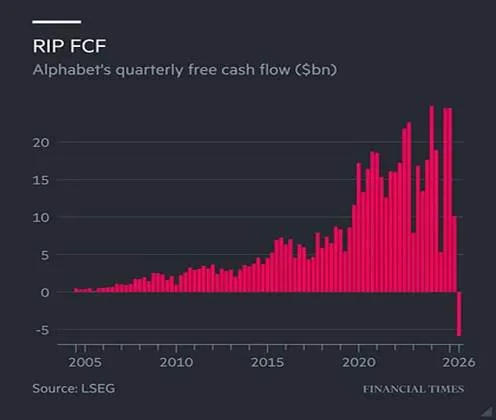
Alphabet lead off the much-awaited earnings reports and delivered strong consolidated operating income which rose 30% to $40.8 billion, with operating margin expanding two points to 34%. More importantly, Google Cloud revenue surged 82% to $24.8 billion, with an operating margin of 35.6%, up from 20.7% a year ago. Cloud drove 63% of Alphabet’s total operating-income growth. But the stock still sold off over 6% following the release because the company went free-cash-flow negative last quarter. The company with arguably the best cash generation in the entire market spent more than it made from operations and stopped returning capital, mirroring a trend across the whole industry. The five largest cloud builders are spending on AI infrastructure at a pace that is 70% faster than their cash earnings growth, and their aggregate free cash flow is set to hit zero this summer. The Alphabet report printed the confirmation of that arithmetic. As to whether you look at Alphabet’s entire report bullishly or bearishly, it depends on whether you focus on the revenue acceleration or the cash burn. But the information from the chart below is illuminating as it shows how Alphabet’s quarterly free cash flow had been increasing over the past 20 years but has melted down to a negative number in the past year. Because annual CapEx has begun to outpace organic free cash flow generation for some players, hyperscalers are increasingly utilizing debt markets, data centre leasing structures, and private credit to finance the buildout. That is one of the reasons why corporate and private credit markets have been under pressure this year as they try to absorb these higher offerings.
The reports from the rest of the group followed with similar results but very different stock market responses. Meta reported earnings in line with expectations but provided less robust guidance, notable since it is the only one in this group that does not own a public cloud but instead relies on advertising on its various platforms such as Instagram, Facebook, Threads and WhatsApp. But the stock sold off by almost 10% following the release, mostly because they increased the bottom end of their capex range for the year by $5 billion. This was a complete reversal from earlier in the month when the stock rallied by over 15% on the rumour that they were going to sell off some of their excess computing capacity to other users such as Anthropic. Clearly investors are telling these companies that they either need to slow down the spending or give much more robust evidence of a return on that spending, which we did get the same day from Microsoft earnings. While capex was increased slightly, the company indicated that they would continue to generate positive free cash flow. More importantly, though, their Azure cloud revenue grew at a 43% annual rate, exceeding expectations and showing how well they are monetizing their AI outlays. The immediate reaction was positive as Microsoft rose 15% the next day, making market history by adding nearly half a trillion dollars to its value, the most by any stock in a single day. Amazon followed the next day reporting that their AWS cloud unit also saw revenue accelerate to a 37% annual growth rate, well above expectations of 31% growth. While they also slightly increased their capital spending plans, investors seemed to give them a ‘pass’ on that given the strong growth in AWS. The stock rallied over 15% on the release. We continue to own all four stocks in client portfolios.
The other mega cap stock reporting this week (which we don’t own) was Apple. Its stock had been one of the winners this year as they have avoided doing the major capex on AI. Apple is taking a radically different approach to AI than its Big Tech peers. Rather than ploughing hundreds of billions into heavy server hardware and massive data centres, Apple maintains an ultra-lean “capex-light” model. It relies heavily on Research & Development (R&D) and cloud partnerships instead of buying massive quantities of GPUs. However, their stock tumbled by the most in 16 months after component shortages weighed on the company’s sales forecast, signalling that industrywide supply constraints are taking a bigger toll than anticipated. In Tim Cook’s final quarter as CEO, they also forecast that revenue would rise 9% to 11% in the fiscal fourth quarter, lower than analysts’ estimates of more than 12% growth, due to constraints and currency fluctuations. They also said the company’s services growth will decelerate in the September quarter, and it warned of an impact from regulatory changes to its App Store business model in the European Union and elsewhere. Given that the stock was trading at the highest valuation in the mega cap peer group, the down move was no big surprise. The reason that all these earnings reports are so important was that the AI data-centre spending binge is helping to mask some of the weakness in the traditional categories of commercial and industrial buildings. Spending on data-centre construction in May rose 23% from a year earlier, according to the U.S. Census Bureau. But beyond data centres, there’s not much moving construction forward not much depth to construction spending right now. U.S. Construction spending on manufacturing buildings dropped 22% year-over-year in May to a seasonally adjusted annual rate of $174 billion.
The other big story for market in July was the Federal Reserve meeting, July 28-29th, which was the second one for new Fed chief Kevin Warsh. The decision was to keep interest rates unchanged in the 3.5-3.75% range was mostly expected but once again, the ‘devil was in the details.’ There was a record three dissents on that decision from the 12 voting members. Those three dissenting regional Fed Presidents had all wanted a ¼ point increase in interest rates to help get inflation down to the Fed’s stated 2% target from current levels more than 3%. Warsh’s press conference following the announcement was the bigger issue though as he puzzled economists and investors, who appear unconvinced the new central bank chief is as committed to stamping out inflation as he says. Warsh, who has said he won’t share his view of when or whether the Fed might adjust interest rates, went further on Wednesday and refused to explain how policymakers might react to different economic outcomes. He praised a run-up in bond yields since the Fed’s last meeting, arguing it was helping the central bank and could mean officials don’t need to raise rates to bring down inflation. Investors responded by continuing to dump 30-year Treasury bonds, sending yields above 5.2%, the highest level since 2007. To the degree he was giving any guidance, he also appeared to dial back expectations for rate hikes over the coming months.
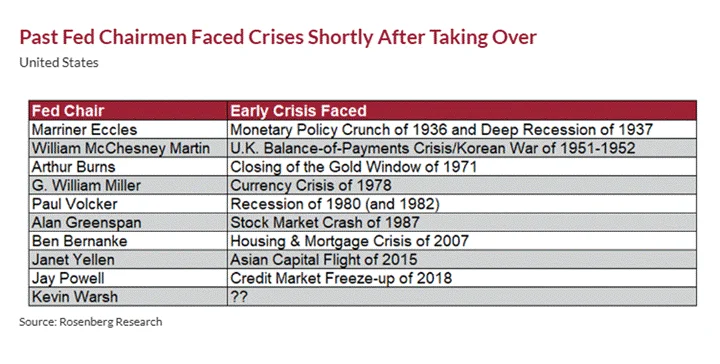
While the fallout in bond and stock markets from the meeting was strong, this is not precedent setting for the early days of the new tenure for all former Fed chiefs. For whatever reason, and perhaps this merely goes under the realm of markets testing a new Fed Chairperson, every single ‘newbie’ has confronted a crisis of sorts shortly after taking over the helm. A pattern not to be ignored. The data go all the way back to Eccles in the 1930s.
1 2
Our investment management team is made up of engaged thought leaders. Get their latest commentary and stay informed of their frequent media interviews, all delivered to your inbox.