Keep connected
Our investment management team is made up of engaged thought leaders. Get their latest commentary and stay informed of their frequent media interviews, all delivered to your inbox.
Jeff Herold
August 7, 2026
Bond yields moved higher in July, primarily due to a resumption of hostilities in the Middle East. Tit-for-tat attacks by Iran and the United States left the June Memorandum of Understanding ceasefire in tatters and the Strait of Hormuz was once again closed to oil and gas tanker traffic. Bond yields climbed as oil prices rose because investors were concerned about the impact on broader inflation. More positive economic data in Canada and mixed messaging from the U.S. Federal Reserve also played roles in pushing yields higher. The FTSE Canada Universe Bond index declined 1.55% in the month.
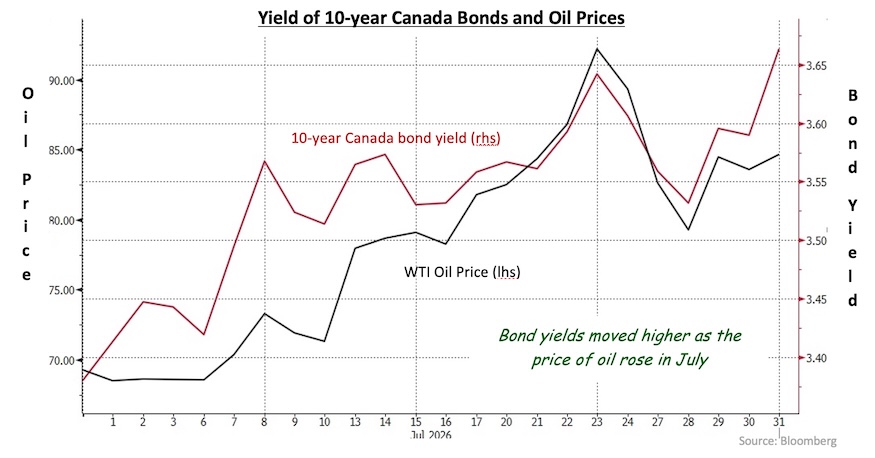
Canadian economic data received during July suggested the economy was beginning to recover from the U.S. initiated trade war. Canadian GDP grew faster than economists’ estimates in May and the year-over-year growth rate accelerated to 1.7% from 1.1%. In addition, the advance estimate of June’s GDP, if correct, meant the economy grew at a robust pace greater than 3.0% in the second quarter. Concerns about a possible recession following weak growth in the previous two quarters evaporated, thereby reducing pressure on the Bank of Canada to lower interest rates. In addition, Canada had a significant trade surplus for the fourth consecutive month. Inflation dipped in June to 2.8% from 3.2% on lower energy prices, but the news was mostly ignored as oil prices had begun climbing again. The Bank of Canada left its interest rates unchanged at its meeting in mid-July.
U.S economic data showed that that economy was in little need of additional monetary stimulus. The unemployment rate remained historically low, declining to 4.2% from 4.3% the previous month, although the improvement reflected fewer Americans looking for work as the participation rate dropped to 61.5% from 61.8%. Early in July, the Fed released minutes of its June meeting, which indicated some members believed inflationary pressures remained too high. However, as in Canada, the U.S. inflation rate declined to 3.5% from 4.2% due to the sharp fall in energy prices in June following the signing of the Memorandum of Understanding. The pace of U.S. GDP growth during the second quarter of the year slowed to 1.5% from 2.1%, but the decline was due to special factors rather than a weakening of underlying activity. The decline was the result of an unexpected drop in inventories as well as sharply higher imports to satisfy robust AI investment spending. Final domestic demand was up a robust 3.2% in the period.
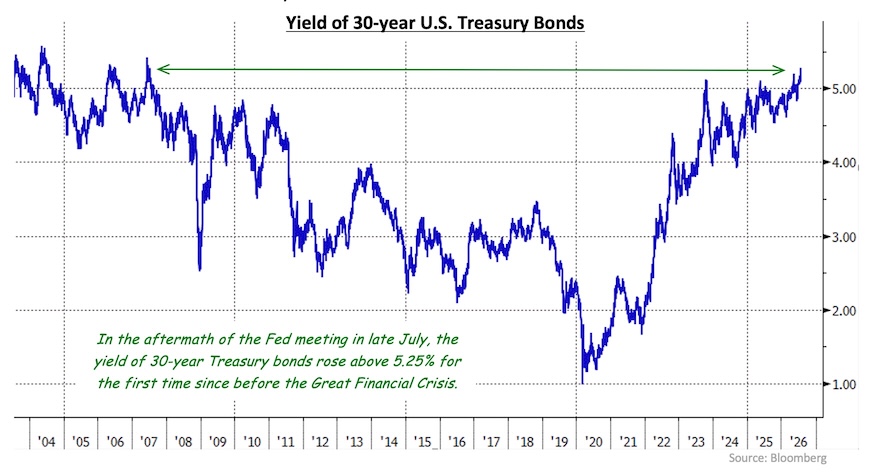
On July 29th, the Fed announced it was leaving its rates unchanged, targeting a range of 3.50% to 3.75%. The decision was not a surprise given the decline in the inflation rate, but it was also not a surprise given the hawkish minutes of the previous meeting that three members of the twelve-member committee dissented, voting for a rate increase. What caught investors’ attention was the inconsistency of Fed chair Kevin Warsh vigorously insisting that the Fed would achieve its 2% inflation target while it left rates unchanged. Given that Warsh has said he wants the Fed to provide much less direction to the markets about potential changes in monetary policy, investors were left confused and long term Treasury bonds sold off very sharply. Over the balance of the month, the yield spiked 15 basis points higher, closing above 5.25% for the first time since early 2007.
Internationally, the only major central bank to adjust its rates in July was the Reserve Bank of New Zealand. It raised its target rate 25 basis points to 2.50%. The European Central Bank, the Bank of England, and the Bank of Japan chose to leave their respective interest rates alone at their July meetings. The Bank of Japan’s decision was curious because it undertook another massive foreign exchange intervention to halt the slide in the value of the Yen when higher rates could have had the same effect. The U.S. Treasury assisted the Bank of Japan in the intervention with a repurchase transaction that saw the Treasury lend the BoJ U.S. dollars and take U.S. Treasuries as collateral. That reduced the amount of Treasuries the BoJ needed to sell and thereby lessened the downward pressure on Treasury bond prices.
The continued debt funding of the massive capital spending on AI, particularly by so-called hyperscalers such as Alphabet (Google’s parent), Amazon, Meta, and Microsoft, pushed yield spreads of both provincial and corporate bonds wider in July, particularly for long term issues. A US$25 billion, 8-tranche new issue by Amazon was especially noteworthy because it initially caused U.S. yield spreads to widen by 20 basis points, although they subsequently recovered most of that move. Canadian yield spreads tracked the changes in U.S. spreads, although the moves tended to be roughly half the size. With AA ratings, the hyperscaler bonds are comparable in quality with provincial bonds but have higher yields. So the widening of spreads for the hyperscalers’ bonds forced competing bonds’ spreads wider.
Notwithstanding the different economic, monetary, and inflationary conditions in Canada and the United States, Canadian bond yields tracked changes in U.S. Treasury yields quite closely in July, except for the late selloff in long term Treasuries after the Fed meeting. With no change in the Bank of Canada’s overnight target, the yield of 2-year Canada bonds rose only 17 basis points. The yields of 5-year, 10-year, and 30-year Canada bonds each rose roughly 26 basis points in the month. The yields of 2-year and 5-year Treasuries increased 15 and 27 basis points, respectively, which were very similar to the Canadian moves. Long term Treasuries were notably more volatile, though, with the 30-year yield surging 38 basis points higher in the month. Given that most U.S. residential mortgages have 30-year terms, the sharp upswing in the benchmark Treasury yield may have negative ramifications for the U.S. housing sector.
The rise in yields in July drove bond prices lower. Consequently, the federal sector returned -1.23% in the month. The provincial sector declined 2.28%, as its longer duration and wider yield spreads negatively affected its returns. While investment grade corporate yield spreads widened, the sector’s slightly shorter duration muted relative price declines resulting in a return of -1.20%. Non-investment grade corporate bonds gained 0.10% in the period, with their high coupons helping to offset small price declines. Real Return Bonds returned -1.83% in July, which was significantly better than nominal bonds with similarly long durations. Preferred shares returned +2.35% in the month, as they ignored developments in the Middle East.
The war between the United States and Iran remains a wildcard for financial markets. The complete lack of trust between the two countries and the absence of any common interests suggest it may drag on for several more months. While U.S. President Trump would like to end the unpopular conflict well before the mid-term elections in early November, the Iranians are also aware of the elections and may be content to stall negotiations until later in November. Consequently, the war may continue to be a source of considerable volatility.
The improvement in Canadian economic growth was a pleasant surprise in July, but we believe the trade war remains a significant risk. The U.S. president’s mercurial, unpredictable, and unreliable policies on tariffs and his desire to dominate all the United States’ trading relationships suggest he may try to implement even more extreme measures. His July threat of 50% tariffs on some imports from Canada may or may not be implemented, but until the CUSMA treaty is finally renegotiated, we should anticipate some economic pain. Consequently, we believe there is little likelihood of rate increases by the Bank of Canada for the balance of this year. Only a significant unexpected economic slowdown is likely to cause the Bank to change its rates this year. Consequently, we prefer to keep portfolio durations modestly longer than their respective benchmarks.
We have been modestly disappointed with the volatility of the spreads on the hyperscaler bonds, but we believe they will ultimately lead to a healthy repricing of most Canadian corporate bonds. As we have frequently said in recent months, we believe corporate yield spreads remain at historically tight levels that do not properly compensate investors for the current level of financial and economic risk. Should the AA-rated hyperscaler bonds remain at their current yield spreads due to supply concerns, we think lower rated corporate bonds will gradually adjust to wider spreads as investors balk at buying them and receiving less interest than on lower risk alternatives. We also believe the provincial sector will similarly need to adjust to wider spreads.
Our investment management team is made up of engaged thought leaders. Get their latest commentary and stay informed of their frequent media interviews, all delivered to your inbox.