Keep connected
Our investment management team is made up of engaged thought leaders. Get their latest commentary and stay informed of their frequent media interviews, all delivered to your inbox.
Jeff Herold
September 2, 2026
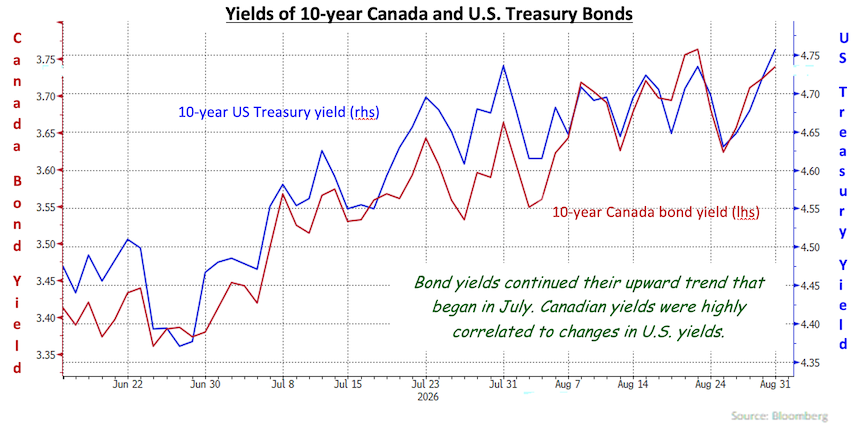
In August, bond yields and prices moved in a seesaw pattern, ultimately finishing with higher yields and lower prices. Canadian bonds were quite correlated with U.S. Treasuries, notwithstanding the differing economic and monetary conditions in the two countries. The trend to higher yields was mirrored in several other global bond markets. The month also featured a noisy breakdown in trade negotiations between Canada and the United States, with the imposition of more punitive U.S. tariffs and the threat of Canadian retaliatory tariffs. The breakdown in talks had little immediate impact on bond markets. The FTSE Canada Universe Bond index declined 0.21% in the month.
Canadian economic data received during August showed a growing resilience to the trade war, albeit prior to the increased threats from the U.S. On balance, the data provided no impetus for the Bank of Canada to adjust monetary policy. Canadian GDP rebounded in the second quarter, growing at a 3.3% annual pace and the first quarter growth estimate was revised to +0.3% from -0.1%, thereby eliminating concerns of a technical recession. The unemployment rate edged down to 6.4% from 6.5%, as robust job creation more than offset higher worker participation. Canada recorded its fourth consecutive monthly trade surplus and retail sales grew faster than forecasts. Inflation accelerated to 3.0% from 2.8% on higher energy prices, but each of the Bank of Canada’s measures of core inflation remained subdued at or below 2.0%.
U.S. economic data continued to show strength. U.S. GDP grew at a 1.5% pace in the second quarter, but underlying activity was significantly stronger. Surging imports of equipment for the AI investment boom reduced the reported GDP rate, while consumer spending increased 3.4% and final domestic demand surged higher at a 4.2% pace. The unemployment rate declined to 4.1% despite job losses, as the participation rate also moved lower. CPI inflation remained high at 3.4%, while core inflation edged slightly lower to 2.5%. A year and a half after the start of the trade war, the U.S. trade deficit for July was reported at $119 billion, up from $101 billion the previous month.
On August 18th, the yield of 30-year U.S. Treasuries touched 5.32%, their highest level since June 2007. A day later, U.S. Treasury Secretary Scott Bessent announced that, starting in September, the Treasury would increase the size of its long term bond buyback operations, from $2 billion to at least $4 billion. That suggested the supply of 10-year to 30-year Treasuries would decrease by an additional $18 billion per quarter, with higher issuance of Treasury Bills and shorter term bonds as an offset. The announcement caused 30-year Treasuries to rally and their yields to decline to 5.24% at month end. Many commentators, though, questioned the relatively small size of the buyback operations and whether they would be effective in stopping the rise in bond yields. Reinforcing investors’ concern about the deteriorating fiscal situation, the U.S. Treasury announced that the national debt had risen above $40 trillion for the first time, having doubled in the last ten years.
Bessent’s apparent attempt to cap long term bond yields also raised questions about whether the Treasury’s policies aligned with the Federal Reserve’s efforts to contain inflation. Fed Chair Kevin Warsh had been heavily criticized for the lack of change in interest rates at the July 29th meeting despite acknowledging higher than desired inflation. So, Warsh’s speech at the annual Jackson Hole conference in late August garnered more attention than usual. Warsh stressed the Fed’s commitment to bringing inflation down to 2% and noted that the U.S. economy was performing very well. The market reaction that day was a 12 basis point jump up in 2-year Treasury yields as investors anticipated an interest rate increase at the Fed’s next meeting in mid-September.
Although all major central banks left their respective interest rates alone in August, yields rose in most major bond markets around the globe. The yield of 10-year German Bunds, for example, rose to their highest level in 15 years, while the 10-year Japanese Government Bond yield climbed to its highest level in more than 30 years. The rise in Japanese yields was particularly interesting because of the coordinated currency intervention that occurred on July 31st and because of the potential implications for the Yen carry trade.
As we noted last month, the Bank of Japan, with the U.S. Treasury’s assistance, intervened in currency markets to bolster the value of the Yen on July 31st. The United States’ participation reflected its concern that Japan, which is the largest foreign holder of U.S. Treasury securities, might become a significant seller leading to a rise in U.S. yields. The U.S. assistance, though, was unusual in several ways. First, the Treasury used repurchase agreements of U.S. Treasury bonds to lend the Bank of Japan U.S. dollars and thereby avoiding the sale of those bonds. Second, the Treasury also supported the Yen but did it not through the sale of U.S. dollars but by selling some of its holdings of Euros. Third, unlike previous coordinated interventions such as the 1985 Plaza Accord, the 2000 rescue of the Euro, and the 2011 post-tsunami Yen intervention, there was no advance discussion or agreement with the central banks involved. The U.S. Treasury Secretary only informed the European Central Bank after the trades had settled. It was once again an example of the U.S. government making a unilateral move with global ramifications, and it reduced confidence in the U.S. as an economic partner.
The Yen carry trade is a decades-old financial structure that took advantage of very low interest rates prevailing in Japan and higher yields available elsewhere in the world. Investors, including large Japanese institutions, borrowed in Yen and reinvested in higher yielding assets in other currencies including the U.S. dollar. The recent rise in Japanese yields, though, is reducing the attractiveness of the Yen carry trade, which may lead to selling of foreign currency assets and repatriation of Japanese investments to Japan. The sale of the foreign assets, or even anticipation of selling, could lead to significant upward pressure on global bond yields.
The Canadian yield curve executed a nearly perfect parallel shift higher in August. The yields of 2-year and 30-year Canada bonds each rose 10 basis points in the month while the yields on 5-year and 10-year bonds rose slightly less. In contrast, the U.S. yield curve flattened in August. Warsh’s hawkish Jackson Hole speech caused 2-year Treasury yields to finish 6 basis points higher in the month, while Bessent’s attempt in capping long term yields resulted in the 30-year Treasury yield closing 3 basis points lower.
Higher yields pushed bond prices lower. As a result, the federal sector of the market returned -0.14% in August. The provincial sector declined 0.30% as its longer average duration meant a greater sensitivity to rising yields. Investment grade corporate bonds returned -0.14% on average, hurt by a 4 basis point widening in long term yield spreads. Corporate new issues totaled $16.2 billion, about twice the average for a usually slow summer month. Non-investment grade corporate bonds fared better, gaining 0.35% in the period. The rise in inflation helped Real Return Bonds outperform nominal issues, gaining 0.19% in the month. The S&P/TSX Preferred Share index also had a positive result, rising 0.27%.
As this is being written, the Bank of Canada has left its overnight target interest rate at 2.25%, as was widely expected. The Bank said it was concerned that the lack of progress in reopening the Strait of Hormuz meant the risk of inflation broadening beyond gasoline prices was increasing. At the same time, the Bank noted the economy was not operating at full capacity plus “uncertainty is high and new US tariffs and threats of further action pose risks to the sustainability of the recovery.” The market’s initial reaction to the Bank’s announcement was that the reference to increased inflation risks was hawkish, but we believe the offsetting risks of rising inflation and weaker growth will keep the Bank on the sidelines for the balance of the year.
As we noted last month, the war between the United States and Iran remains a wildcard for financial markets. The complete lack of trust between the two countries and the absence of any common interests suggest it may drag on for several more months. The upcoming mid-term elections in the United States in early November combined with the unpopularity of the war in the U.S. mean Iran has little reason to negotiate a settlement in the next couple of months.
The upcoming mid-term elections may also have an impact on the trade war between Canada and the U.S. Political polls currently suggest the Republican party may lose control of both the House and the Senate, and if the polls do not improve the Trump Administration may become more accommodating in negotiating a trade agreement so as to achieve some positive news. In other words, Canada’s negotiating leverage should improve until the elections, but will fall after then.
We are increasingly concerned about weakness in global bonds posing a risk to the Canadian bond market. In addition to the lack of fiscal discipline globally, the unwinding of the Yen carry trade could put significant upward pressure on bond yields. The Bank of Japan is under substantial pressure to stabilize the value of the Yen, because its depreciation is leading to higher Japanese inflation as import costs rise. Interventions by the BoJ are providing only temporary relief for the Yen, and it needs to raise interest rates to provide a longer lasting solution. Higher interest rates, however, will likely lead to rising Japanese bond yields that, in turn, will lead to more unwinding of the Yen carry trade which involves selling foreign bonds including Treasuries and Canada bonds.
We are modestly cautious regarding corporate bonds because we believe corporate yield spreads are at historically tight levels that do not properly compensate investors for the current level of financial and economic risk. Should the recently issued AA-rated hyperscaler bonds hold their current yield spreads due to supply concerns, we think lower rated corporate bonds will gradually adjust to wider spreads as investors balk at buying them and receiving less interest than on lower risk alternatives. We also believe the provincial sector will similarly need to adjust to wider spreads.
Our investment management team is made up of engaged thought leaders. Get their latest commentary and stay informed of their frequent media interviews, all delivered to your inbox.