Keep connected
Our investment management team is made up of engaged thought leaders. Get their latest commentary and stay informed of their frequent media interviews, all delivered to your inbox.
John Zechner
August 31, 2026
Stocks kept moving higher in August in both Canada and the U.S., despite the breakdown of trade talks and comments from Fed Chairman Kevin Warsh at the annual Jackson Hole symposium that he was determined to bring inflation back down to their 2% target, suggesting that interest rates would be headed higher at one of their upcoming meetings. But the economic data continued to be supportive of growth which gives investors more confidence in ongoing earnings growth. Heading into the final afternoon of trading for the month, the S&P/TSX Index in Canada was up 3% on the month while the S&P500 in the U.S. was up about 2.5%. Canadian stocks were lead higher by exceptional strength in the gold and base metals stocks and a recovery in tech stocks. But some other major sectors, such as energy, financials and industrials, had negative returns on the month so the gains were certainly not broad-based. A similar story in the U.S. where big technology stocks rose over 4% to carry indices higher. Blockbuster earnings from semiconductor giant Nvidia supported the move higher as they reaffirmed the ongoing strong demand (and tight supply) for semis and the expectation that data centre spending is not slowing down anytime soon, which has been the major tailwind for the economy. But now we head into the seasonally-weakest two-month period for the stock market just as Canada and the U.S. seem to be headed to an all-out trade war. So far, the stock market has treated all of this as ‘noise’ but with stock valuations so high, sentiment so bullish and investor portfolio positioned so aggressively, we continue to play a bit more ‘defence’ when it comes to portfolio positioning.
The bigger domestic story has been the collapse of trade talks with the U.S. putting import taxes of 50% on certain items using a never-before-used provision of a 1930s-era law to impose these new tariffs against a trade deal (USMCA) that they themselves negotiated! Carney has spent much of his time in office until now trying a conciliatory approach with the U.S., while diversifying Canada’s economy. He rolled back retaliatory tariffs applied by Justin Trudeau, axed a digital services tax that irked Trump, and re-cut a deal in the US’s favour to open the Gordie Howe bridge. But the more that Canada conceded, the more the U.S. would look for further concessions. Carney slammed the US for violating the USMCA trade deal with tariffs over the past 18 months and accused the White House of continuously changing its justifications for trade measures, including fentanyl trafficking, Canada’s dairy policy, a television commercial that Trump didn’t like, wildfire smoke and a trade deficit. The U.S. has proven to be an unreliable partner under Trump for all its former closest allies, including Canada, the EU, South Korea, Australia and even Japan. Retaliatory measures were the only option where Canada could apply some negotiating leverage. The U.S. still needs our Energy and critical mineral assets and those will likely stay tariff free, but additional tariffs on products from “politically significant” states for Trump, such as Florida, Texas, Iowa and Wisconsin would certainly make an impact.
Our view is that Carney’s response is the right one. Trump believes it can bully Canada into a deal that is clearly tilted towards the U.S. side and that the negative impacts to the U.S. are not significant. That may not be rational or logical but that is the case. But Trump has only a little over two years left in office and, if he loses control of the House and/or the Senate in November will have less ability to impose his ‘executive action’ will on the rest of the world. We expect that Canada-U.S. relations will start to slowly normalize again once Trump is out of office, irrespective of which party takes control of the next administration. The history of close association between the two countries is centuries old and will not be permanently changed by one rogue administration. Almost every business leader, governor, union leader or political representative on either side of the aisle want normalized relations with Canada as well as all their other traditional allies. In the meantime, Canadian consumers will buy fewer U.S. goods and probably continue to travel less across the border while we build stronger domestic businesses, spend on infrastructure and increase trading relationships with the rest of the world. Most of the readings on this conflict have shown much more support for Canada and we might see other nations start to push back against these U.S. unilateral decisions that impact global growth to the detriment of most. The upcoming G20 meetings, which are usually somewhat of a ‘non-event’, might have some more news making conversations Carney seems all alone in the trade world, tilting at Trump’s tariffs fortress. But appearances can be deceptive. Even though EU leaders will not publicly join his anti-Trump crusade, they are endorsing him in more subtle ways. He will attend the EU’s State of the Union address to be given by EU President Ursula von der Leyen on Sept. 16 in Strasbourg. The next day, he will address the EU parliament. It’s impossible to imagine that Trump would receive the same invitation (the last U.S. president to address the parliament was Ronald Reagan, in 1985). If we can’t cut a fair-trade deal with the U.S. maybe Canada should consider joining the EU!!

The Bank of Canada is expected to bide its time this week as it wrestles with an escalating trade war that risks pushing up consumer prices while hammering economic growth. The odds of an interest-rate hike or cut were already low heading into the fall but the strong economic data in the second quarter did raise the possibility of a hike. Now, the breakdown of trade negotiations between Ottawa and Washington – followed by tit-for-tat tariff threats – makes it even more likely the bank will keep its benchmark interest rate steady at 2.25% at Wednesday’s rate announcement
The other big event last month came from the U.S. Treasury, which appeared to try to draw a ‘line in the sand’ on long term interest rates. Scott Bessent’s move to try to control the long end of the yield curve met with limited initial success. Long term interest rates have surged to the highest level in 20 years as U.S. tech companies have been flooding the debt markets with new issuance to pay for all their AI spending. With the weakness in the housing market due to surging mortgage rates, the Treasury tried to relieve some of the upward pressure with an ‘’operation twist’ similar to what the Federal Reserve did after the financial crisis. The idea is for the Treasury to buy longer dated securities and fund that with the further issuance of shorter-term debt. The problem here was that the operation only involved $4 billion in purchases, a miniscule amount considering that the U.S. debt rose above $40 trillion for the first time in the past week. The bigger problem here is that they are ‘treating the symptoms rather than the cause!’ The only way to get relief at the longer end of the curve is to begin reducing the deficit. The national debt has climbed from $10 trillion in 2008 (pre crisis) to the current level as successive administrations continue to spend at increasing rates while also cutting taxes, leading to record fiscal deficits at levels never seen in non-war, non-recessionary times. How this ends is anyone’s guess but our view on the best investment strategy is to maintain a position in gold/ gold stocks. The U.S. dollar will be the ultimate casualty of these excesses and gold will continue to absorb some of that selling, particularly from central banks as they diversify away from U.S. treasuries.
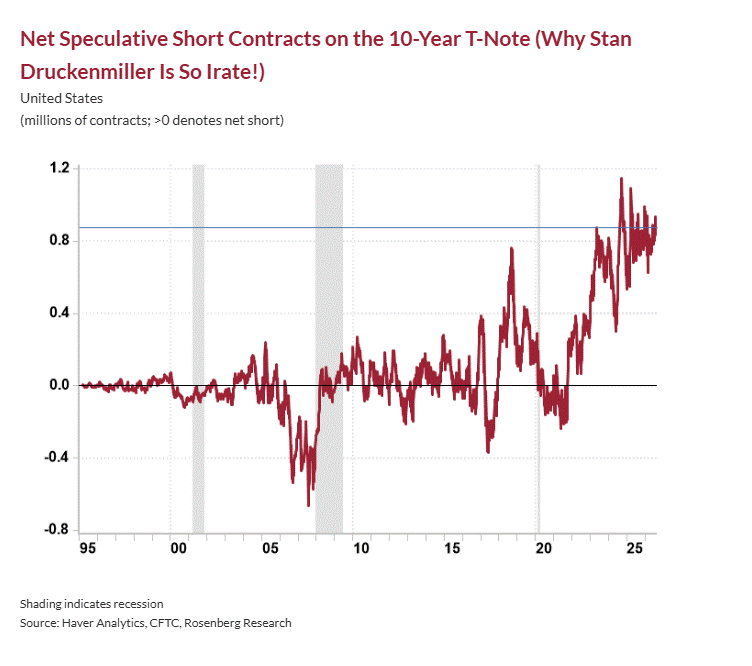
Everybody loves the stock market, but contracts show that everyone hates the bond market! For the contrarian investor the bond market must be at least looking like a good hedge against stock market exposure. Surging budget deficits and debt issuance from the giant tech companies that used to generate massive free cash flows has pushed interest rates higher. We still believe that core inflation is still coming down and that economic growth is riding far too heavily on the ‘one-legged stool’ of the ongoing data centre spending which, in combination, would begin to relieve the upward pressure on rates. Meanwhile, as shown in the chart below, investors and hedge funds and speculators are all positioned for interest rates to continue higher with ‘net short’ positions on the U.S. 10-year bond at the highest level ever.
Has the SaaSpocalyspse been repudiated? Salesforce’s recent blowout earnings show why the balance of power may be shifting away from frontier models and back toward software companies that investors had prematurely left for dead. For months, analysts have assumed that frontier large language models will accrue an ever-greater share of the value created by AI, with the valuations of those companies soaring commensurately. But intelligence is precisely the thing being commoditized before our eyes: Frontier models now leapfrog one another every few months, growing ever more capable but also increasingly interchangeable. Salesforce is one of the largest repositories of enterprise customer data in the world, and far from being the beneficiary of lucky earnings beat or one-time aberration, it may be positioned as a long-term structural winner from the commoditization of AI. Agents cannot work without data, so the data keeps flooding in: Salesforce’s Data 360 ingested a staggering 104 trillion customer records this quarter, up 355% year over year. Meanwhile, AI agents themselves generate still more data, all of which has to land somewhere trusted. Salesforce delivered 3.2 billion units of agentic work this quarter, nearly double the prior quarter. Not all software firms will flourish in this new world. Firms with proprietary data that is valuable to AI agents should be better positioned to prosper, while software companies that offer little beyond functionality — and have few other sources of customer stickiness — could struggle. While we need to tread carefully between the potential winners and losers in the software space, we believe that we have passed the period of maximum pessimism and, with many stocks in the sector trading below market multiples, we are more inclined to stick with the group.
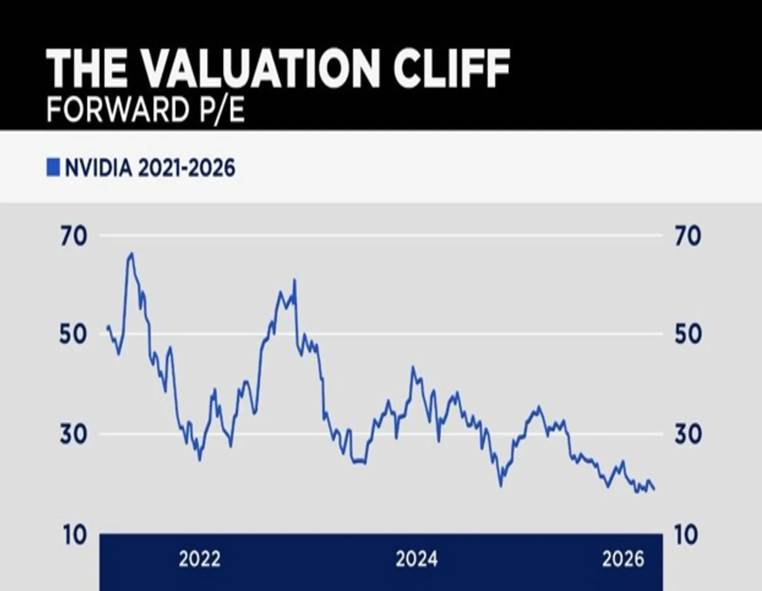
Meanwhile, Nvidia’s blowout earnings report did contain some red flags worth noting. From January to July, Nvidia reported a roughly 63% rise in net accounts receivable, from $38.5 billion to $63.1 billion. This shows a hefty increase in the number of orders the company has filled but hasn’t been paid for yet. While its income backlog is growing, Nvidia’s backstopping promises to customers and suppliers on the other side of its balance sheet are also getting bigger, amplifying a chorus of criticism over circular financing. Commitments more than doubled from $119 billion in the first quarter to $279 billion in the second, primarily due to memory chip component requirements. Amid the balance sheet pressures, Nvidia’s free cash flow also took a hit in the second quarter, dropping to $21 billion from $49 billion in the first quarter – way below estimates. Investors seem to be taking the cautious view as Nvidia forward earnings multiple has dropped close to its lowest level in its entire trading history since going public in 1999. There is precedent from recent history that might be relevant. Apple (AAPL) in the years following its initial iPhone-release profit bonanza saw its valuation slide down a similar slope (in an early-2010s market that itself was less expensive than today’s).
These signs all raise the important question, is the AI bubble about to burst? The scale of AI capital expenditures has been astounding. Since the start of 2024, roughly $500 billion has been spent on chips, $350 billion on power infrastructure, $200 billion on construction, and $100 billion on networking. That dwarfs the roughly $575 billion of capex from the entire S&P 500 in 2021, the year before OpenAI’s ChatGPT launched. As long as companies were paying for AI out of free cash flow, no one seemed to mind. But now, the cash-flow machines of old— Amazon, Alphabet, Meta Platforms, and Microsoft, among others—are going into hock to pay for their AI data centres, and the worries are growing. And for good reason. The amount they aim to spend is staggering —some $2 trillion over the next two years—and concerns are starting to show up in debt markets, where the cost to insure against a credit default has skyrocketed. Wall Street is also fretting about the stocks. Shares of AI companies have dropped 20% from a June 52-week high. It’s enough to make an investor ask if the end of the AI trade, if not the AI buildout, is upon us. The current rush for AI-related infrastructure build resembles the railroad boom of the 1850s, as well as the internet/broadband boom of the late 1990s. Just like these previous periods, the AI build is financed by shareholders of public companies as well as bond investors and private credit. The rationale for AI computer capacity (i.e. storage, memory and overall performance) is like the railroad expansion and the belief that if we build it, customers will come. Or that “supply creates its own demand.” But a few years after all the capital expenditures for the railroad infrastructure had been spent, investors realized that the return on their investment would not meet what they had been promised. As a result, a quarter of all railroads in the United States and the United Kingdom ended up in receivership.
Taking all of this into consideration, what is the best investment strategy for continued growth as well as capital preservation? We added some U.S. long term bonds holdings as a hedge against ongoing stock market gains as well as our expectations that economic growth is slowing down and core inflations is receding back to its target level. Gold stocks continue to be a large holding for the same reasons we added bonds but also as protection against a deterioration in the U.S. dollar. We continue to hold a healthy weight in technology stocks since they are delivering the strongest earnings growth across the entire market. However, we have sold most holdings related to ongoing data centre spending and a semiconductor market where we see risks. Hyperscalers such as Amazon, Alphabet, Microsoft are showing accelerating cloud computing growth at rates exceeding 50%, which shows how well they are monetizing their AI spending. Meanwhile, Meta stands out as a great value within the sector with 3.6 billion daily active users of its ‘family of apps’ which gives it tremendous leverage in the mobile advertising world. We continue to hold Canadian energy stocks due to their low valuations, long-lived reserves and growing favour among international investors due to geo-political stability in Canada. We have eliminated positions in bank stocks in both Canada and the U.S. Valuations are at excessive (and what we view as ‘unsustainable’) levels. Growth has been driven largely by capital markets activities, trading and wealth management, which have all been helped by strong stock markets. However, this over-dependence on continued strong markets is a concern. The fact that the entire sector sold off on the recently released 3rd quarter earnings reports, which all exceeded expectations, show that the bar is set very high for this group. They are still great long-term investments, but we see better opportunities elsewhere in the short term. The consumer sector also looks to be on shaky ground, particularly with the trade war with the U.S. heating up. We prefer defensive holdings such as power utilities, alternative energy and telecom, where the valuations are at the low end of historical ranges and the dividend yields remains attractive.
Our investment management team is made up of engaged thought leaders. Get their latest commentary and stay informed of their frequent media interviews, all delivered to your inbox.