Keep connected
Our investment management team is made up of engaged thought leaders. Get their latest commentary and stay informed of their frequent media interviews, all delivered to your inbox.
Jeff Herold
October 2, 2026
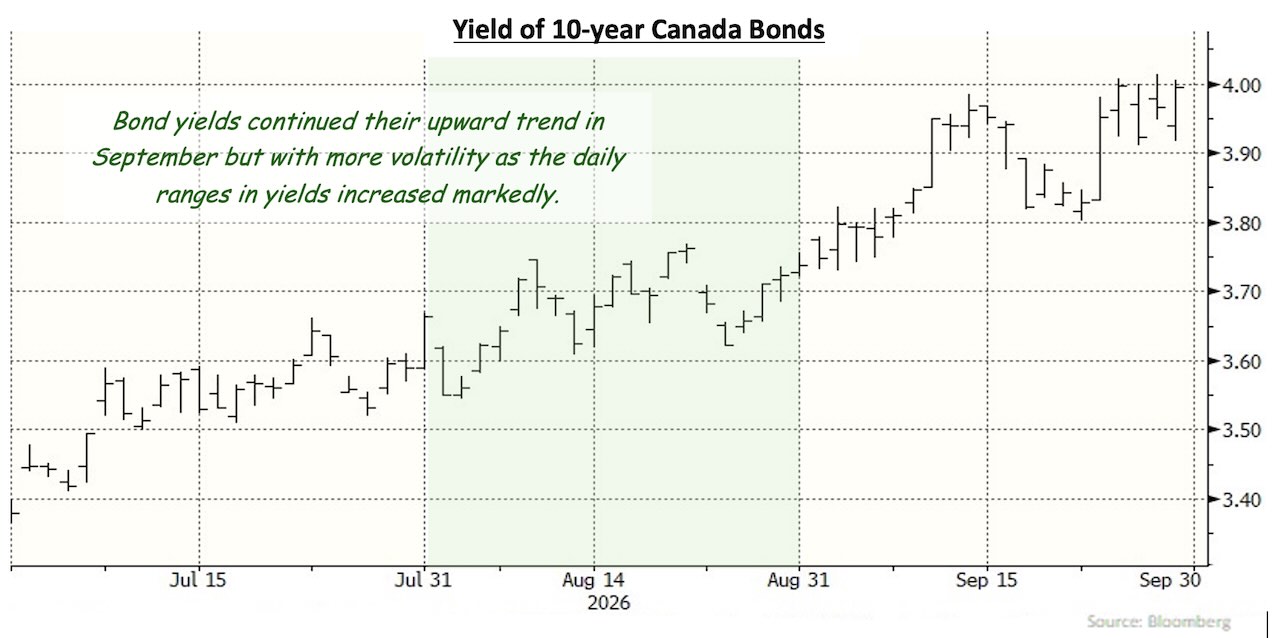
The global selloff in bonds accelerated in September, led by sharply higher U.S. bond yields. A jump in oil prices in the first half of the month played a role in the rise in yields. However, oil prices gave up much of their gains in the second half of the month, but yields continued to move higher. Volatility was elevated compared with recent months, especially on September 23rd when the bond market experienced its worst day since the Liberation Day tariff announcement in April 2025. A defiant U.N. speech by Iran’s president helped trigger the weakness, but interest rate increases earlier in the month by several central banks, including the U.S. Federal Reserve, also played a role. The FTSE Canada Universe Bond index declined 1.22% in the month.
Canadian economic data received during September showed the economy was growing, but slower than its potential pace and with excess capacity. Year-over-year growth in Canadian GDP slowed to 1.4% in July, but preliminary estimates for August showed a rebound to 1.8% growth. Similarly, retail sales declined in July, but StatsCan’s flash estimate for August showed a very strong recovery. The unemployment rate held steady at 6.4% as a decline in the participation rate offset a drop in total jobs. Importantly for the Bank of Canada, CPI inflation held steady at 3.0%, with little broadening away from energy as the core measures of inflation remained close to 2.0%. The Bank of Canada left its overnight target rate at 2.25% but indicated it was concerned about high energy prices potentially leading to more widespread inflation.
The Bank of Canada’s decision to leave interest rates unchanged was in contrast to many other central banks during September. Starting with the Reserve Bank of New Zealand, followed by the European Central Bank, the Fed, the Bank of Japan, Norway’s Norges Bank, and the Reserve Bank of Australia each raised their interest rates by 25 basis points in response to inflationary pressures in their respective countries. Importantly, investors in those countries’ bond markets believed further rate increases were likely, which led to bond yields rising.
U.S. data showed that the U.S. economy was performing well. The unemployment rate held steady at the historically low 4.1% level. Job creation was robust and prompted discouraged workers back into the work force as the participation rate rose. The strong labour market made consumers optimistic and retail sales were stronger than expectations. The only significant weakness was in housing as starts of new homes disappointed even before the bond market selloff pushed mortgage rates above 7.00%. Inflation remained elevated at 3.4%, with the impact of the recent surge in energy prices yet to be reflected in the data. As noted above, the Fed raised its interest rates by 25 basis points at its mid-month meeting. The move was expected to be the first of a series of increases.
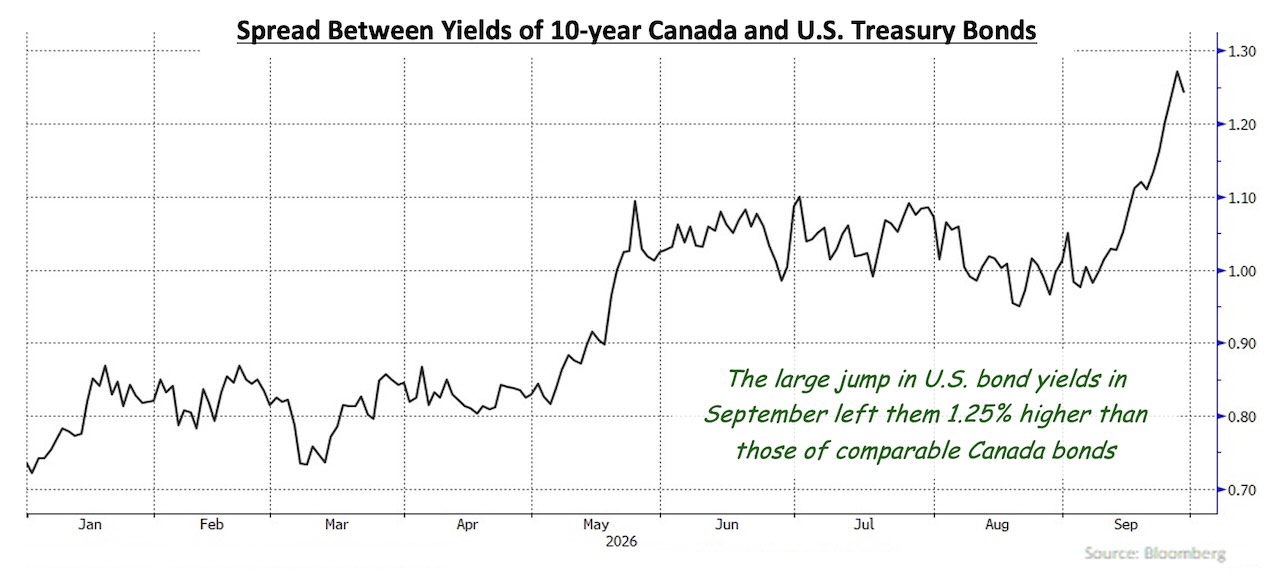
The Canadian yield curve moved higher and flattened significantly in September. The yields of 2-year and 5-year Canada bonds climbed 36 basis points, while 30-year yields rose only 16 basis points. While the changes in Canadian yields were substantial, they paled in comparison with those in the U.S. bond market. The yields of 2-year, 5-year, and 10-year U.S. Treasuries each jumped by more than 55 basis points in the month, while 30-year yields rose a remarkable 40 basis points. The increases in 10-year and 30-year Treasury yields left them at their highest levels since 2002. Consequently, the spread between U.S and Canadian bond yields widened sharply.
The federal sector of the Canadian bond market returned -1.22% in September as the higher yields caused bond prices to move lower. The provincial sector declined 1.56% as its longer average duration meant relatively larger changes in its valuation. Investment grade corporate bonds returned -0.81% on average, as strong demand caused corporate yield spreads to tighten an average of 3 basis points. Corporate new issues totaled a robust $17.65 billion and brought the year-to-date total, $162 billion, above the amount raised in all of 2025, which was a record year. Non-investment grade corporate bonds returned -0.09%, as their high coupons and low durations offset a 15 basis point increase in their yields. Real Return Bonds returned -0.33% in September, substantially outperforming nominal bonds as the elevated CPI spurred interest in inflation protection. The S&P/TSX Preferred Share index fell 2.53%, with perpetual type shares experiencing more weakness than rate reset issues.
We believe the Bank of Canada is unlikely to change its interest rates over the remainder of this year. The twin concerns of inflation and relatively weak economic growth should keep balancing each other for the next few months. However, we are monitoring inflation closely as a significant broadening of price increases outside of energy might prompt the Bank of Canada to increase rates. If we are correct about the Bank, September’s yield curve flattening should reverse because short term yields rose sharply in anticipation of Bank of Canada rate hikes. However, the correlation of Canadian bond yields with global ones during the recent selloff occurred despite differing central bank approaches, so we are cautious about extending duration. Should other central banks, including the Fed, continue to raise interest rates while the Bank of Canada stands pat, we may see some additional weakness in the Canadian dollar.
As this is being written, the U.S. mid-term elections are roughly a month away. With polls suggesting the Republican party is at risk of losing control of both the House and the Senate, U.S. President Trump is becoming increasingly desperate for some policy successes to try to reverse his deteriorating approval ratings. The Iranian government, though, seems unlikely to want to assist Trump, so any ceasefire or truce will have to wait until after the elections. Oil prices will therefore continue to be elevated and volatile, which will mean inflation concerns will continue to impact the bond market.
Canadian trade negotiators, though, may be able to reach agreement with their U.S. counterparts in October, because of the pressure on Trump to achieve any credible success before the election. After the election, Canada’s leverage will diminish in our opinion.
As we noted last month, we are cautious regarding corporate and provincial bonds because we believe yield spreads are at historically tight levels that do not properly compensate investors for the current level of financial and economic risk. Should the AA-rated hyperscaler bonds hold their current yield spreads due to supply concerns, we think lower rated corporate bonds will gradually adjust to wider spreads as investors balk at buying them and receiving less interest than on lower risk alternatives. We also believe the provincial sector will similarly need to adjust to wider spreads.
Our investment management team is made up of engaged thought leaders. Get their latest commentary and stay informed of their frequent media interviews, all delivered to your inbox.